History
The ‘New’ Church
Looking to the Future
By 1876, the construction of a railway line to North Queensferry was underway (the old line to the Railway Pier) and plans for the Forth Bridge were afoot. This was expected to improve the status of the village.
Dunfermline Press Saturday Jan 01 1876, Soiree and presentation at North Queensferry
Last Tuesday, a soiree was held in the Mission Hall to mark the departure of the Rev. Robert Kay who has laboured here during the last eight months as a missionary, in connection with the Free Church.
1878 The New Free Church
Dunfermline Press – Saturday July 13 1878.
Opening of the new Free Church at North Queensferry.
Saturday July 20 1878 – Opening of the new Free Church at North Queensferry.
The want of a place of worship has long been felt in Queensferry, and to those who had the wish to be regular attenders on the services of the sanctuary, the want was deeply felt. Inverkeithing, where the nearest place of worship is, is two miles from it, and on any stormy or wet day, to go that distance to church was out of the question.
How long this state of things would have continued it is not for us to say; but we believe that the late Provost Robertson was the first to try to amend matters, by providing a place where religious services could be held. After his death, the matter was taken up by the Rev. Mr Brydie, late of St Andrew’s Free Church, who did his utmost to establish a place of worship in the village, but he was called away to another sphere of labour before it was accomplished. With the addition of the railway to the village, and being in close proximity to Dunfermline, it was thought that many would take advantage of Queensferry as a summer resort, and the Free Church Presbytery of Dunfermline then took up the matter of providing religious ordinances for the people, and a committee was formed for that purpose.
The Hall in connection with the Hotel was secured, and the Rev. J. M. Allan, late of Canada, was engaged to labour in the district; and he has done so with such success as to obtain a grant from the Home Mission Fund for its constitution as a Mission Church.
A scheme was then organized for the erection of a church and hall by the Rev. Mr Shiach, of the Free Abbey, Dunfermline – which project, however, fell through and was abandoned. A number of influential persons, however, took an interest in the matter, and a fund was raised by voluntary subscriptions – among the subscribers to which was Mr Elder of St Margaret’s, who, in addition to presenting the Presbytery Committee with the site of the Church, gave the handsome donation of £100. His brother followed with a similar sum. Mr Sivright of the Cliff, gave £30; and Mrs Douglas, Craigdhu; Mr Henderson, Fordell; and Mr Newton, of Castlandhill, subscribed £25 each. These sums, along with a number of smaller gifts, raised the building fund up to between £400 and £500.
The amount of interest thus manifested in the scheme made the Presbyterial Committee feel justified in setting “the ball a-rolling;” and Mr Scobie, architect, was communicated with, who prepared plans for the erection of the Church, which were approved of, and the building was thereafter commenced, and, after a lapse of fully three months, has been erected.
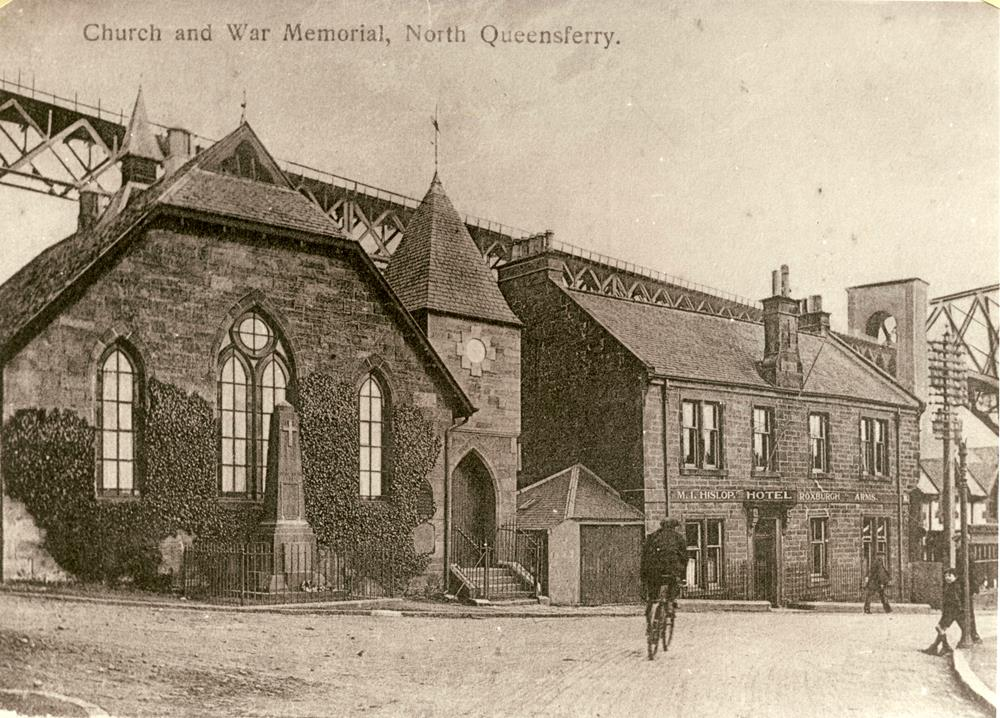
The Church, which in every way harmonises with the locality in which it is located, is in design a simple adaptation of the Gothic style of architecture, and is situated at the entrance to the village on a commanding site overlooking the sea. The front elevation presents a gable with a central mullioned window, having the lights finished with elliptical beads mitred into a circular frame. On either side of the window a smaller light is placed, corresponding in style with the principal aperture. The entrance door, which, along with the minister’s room, is situated to the right of the front of the building, is surmounted by an elliptical head, and the whole front is finished in fine-dressed freestone. The windows throughout the design are finished with freestone dressings, while the walls have been built with whin rubble. The north and south elevations are lighted by single windows with cusped lintels. The roof is highly pitched, and crowned with a belfry-turret, the bell of which has been presented by Mr Wilson.
The interior of the building, which has a very comfortable appearance, is seated for about 230 persons, the seats being fixtures with bound backs made of yellow pine. A platform has been erected instead of a pulpit for the accommodation of the minister, and the walls are wainscoted five feet high.
Altogether, the building is a very unique production, and reflects great credit on Mr Scobie, and the several tradesmen employed in its erection, and will, no doubt, be much appreciated by the villagers. Mr Arnot, merchant, Inverkeithing, had kindly presented the Church with chandeliers for the lighting up of the pulpit and the lobby.
There were two services: –
Morning, at 11 o’clock, – Rev. James Begg, D.D. Afternoon at 3 o’clock, – Rev. J. M. Allan, M.A.
Collections were taken in aid of the Building Fund.
Donations to be received by the Rev. J.M. Shiach, Free Abbey Church, Dunfermline.
Location of the Free Church
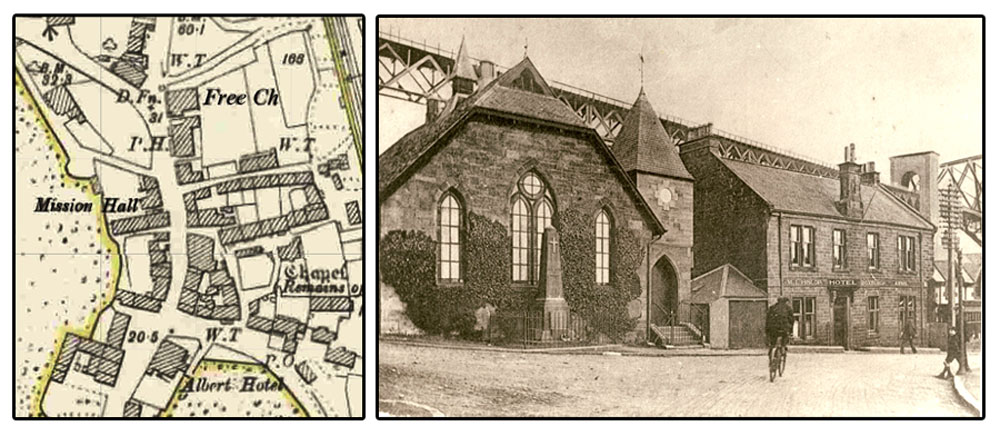
The church stood at the foot of The Brae, at the end of what is now Old Kirk Road.
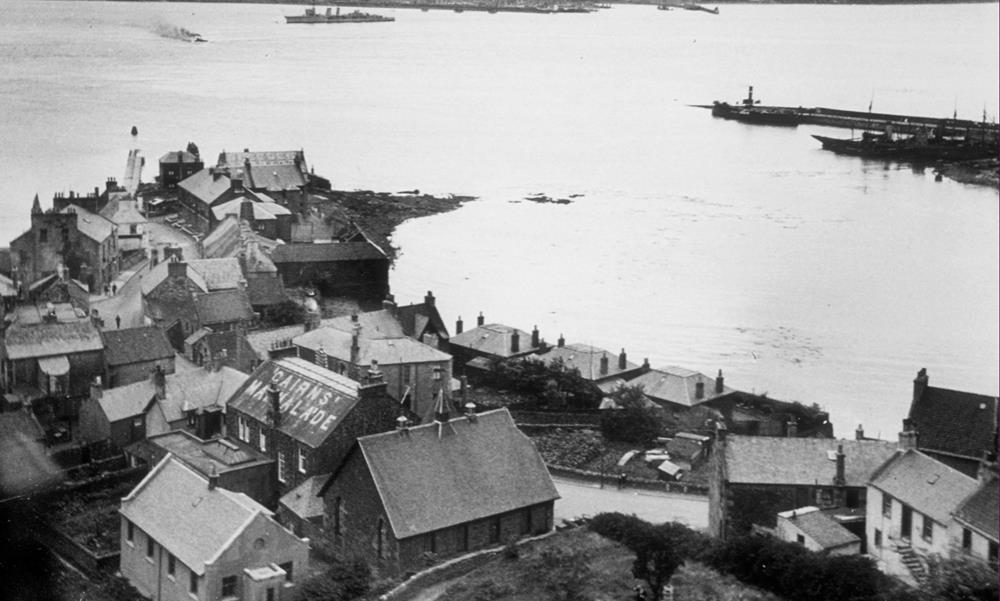
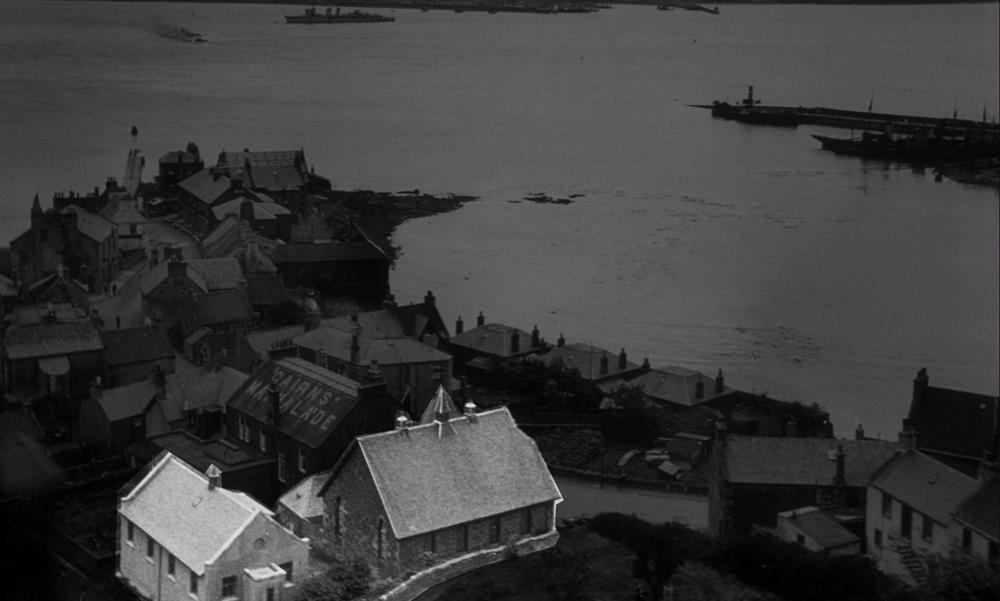
The church and its associated church hall are seen here at the bottom left of this photograph. (Highlighted for clarity in the image below)
The hotel next door (the present Ferry Bridge) carries an advert for Cairns Marmalade.
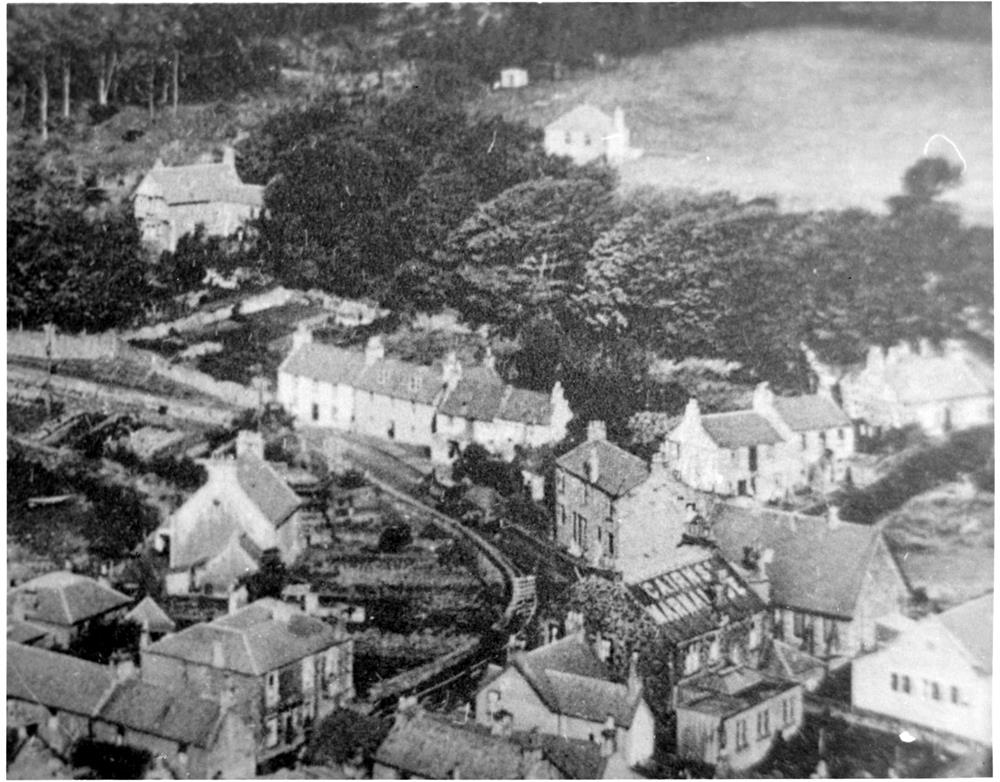
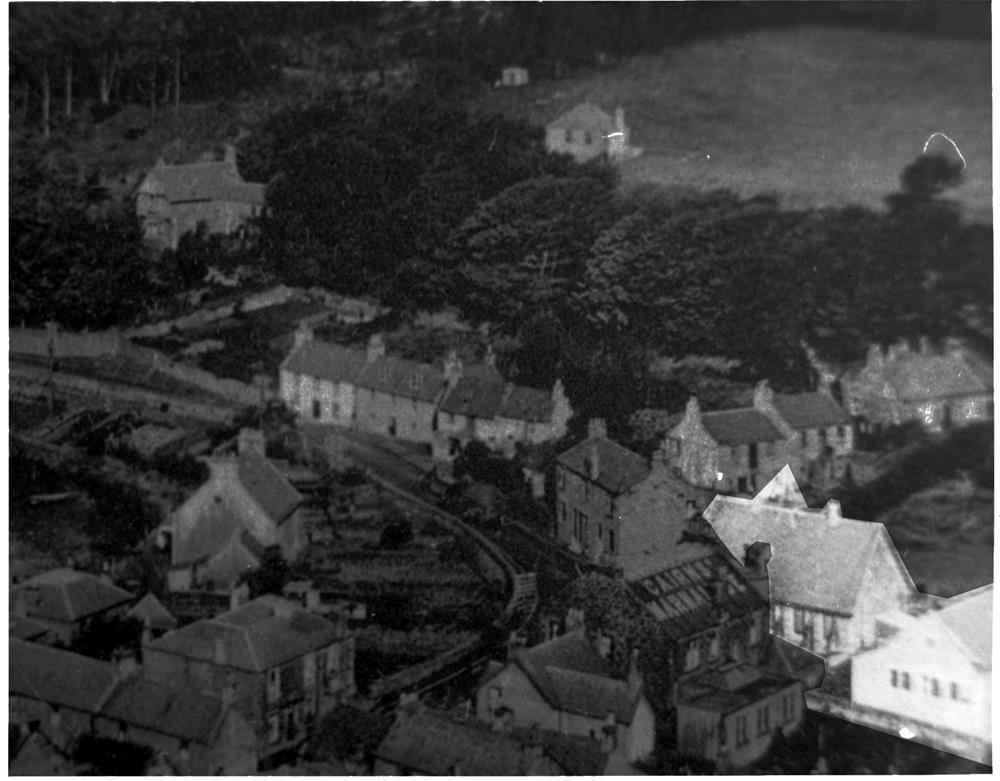
The church and its associated church hall are seen here at the bottom right of this photograph
(Highlighted for clarity in the image below)
The War Memorial was erected in 1921, and originally stood outside the old church.
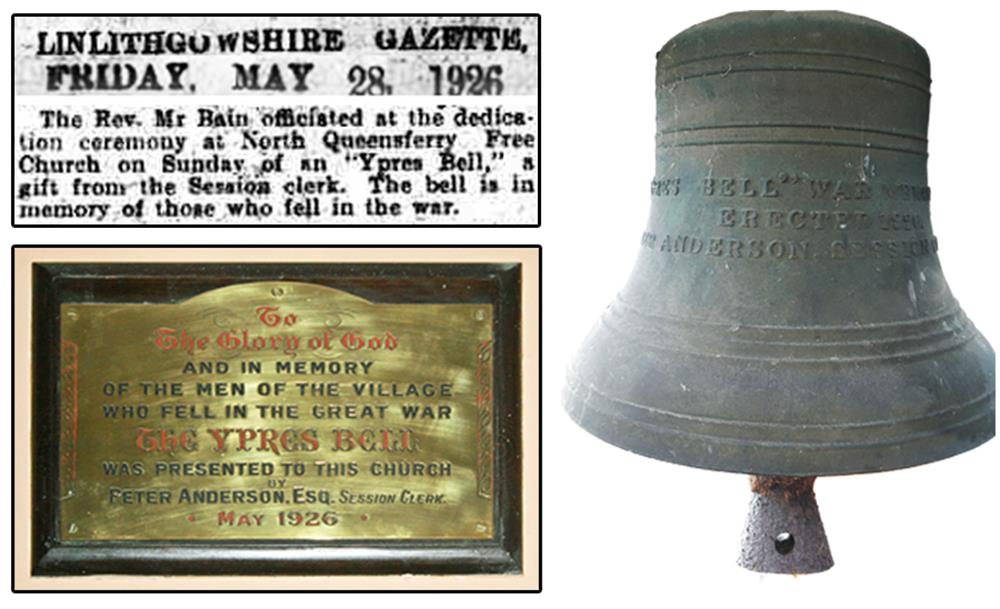
1926 – The Ypres Bell
On Sunday 23rd May, the Rev. Mr. Bain officiated at the dedication ceremony at North Queensferry Free Church of an “Ypres Bell,” a gift from the Session Clerk, Peter Anderson. The bell was in memory of those who fell in the war.
A wall plaque commemorates the occasion. The bell itself carries the cast inscription:
The “Ypres Bell” War Memorial 1914-18.
Erected 1926
By Peter Anderson Session Clerk.
It is not known if the “Ypres Bell” replaced the belfry bell presented by Mr Wilson in 1878, or if it hung somewhere inside the church.
20th Century Changes
The church passed successively to the United Free Church (in 1900) and the Church of Scotland (in 1929), but was reduced in status in 1939 and is said to have been worked thereafter by probationers until 1951.
The Church of Scotland charge was linked with Inverkeithing St John’s in 1958 and became linked with Inverkeithing on the union of St John’s and St Peter’s on 5th November 2006. It was formerly in the presbytery of Dunfermline and Kinross before this became Dunfermline and was in the synod of Fife until the abolition of synods in 1993.
Ministers in the ‘New’ Church
1878 – Rev. Shiach instituted services
Kirk Session minute book prior to 1926 is apparently in the hands of the National Archives of Scotland CH3/1294 and requires research to identify personnel prior to 1926
1926 – Rev. A.W. Bain inducted to North Queensferry United Free Church. He led the Congregation into the Church of Scotland in 1929 and died 19 May 1929
1929 – Rev. J. Miller Graham inducted 12 September. He retired 31 Mar 1939
1940 – Rev. Wm. A. Simpson (Assistant-in-charge under Dunfermline Abbey) appointed Mar 1940
1944 – Rev Daniel E. Gunn (Assistant-in-charge under Dunfermline Abbey) app.19 Feb 1943, he had left by Dec 1944
1951 – Rev. Harry J. Marr inducted 18 July, retired 15 March 1955
1955 – Rev. James L. McLeod inducted December 1955. Left at Jul 1958 on Linkage with Inverkeithing St John’s
1958 – Rev. D. C. Moir (St John’s) from July 1958, until March 1962
Session Clerks in the “new” church
1926 – Peter Anderson
1938 – W.J. Mathewson appointed 25th December 1938
1939 – Rev. Simpson served as Clerk from October 1939 for Rev. Robert Dollar, Interim Moderator
1962 – Demolition of the ‘New’ Church
A scant eighty-four years after the “new” church was opened in 1878, the building had degraded, and was deemed to be beyond economic repair.
In March 1962 it was proposed to authorise the demolition of the old Church; services were held in the School meantime. The problem is said to have involved the roof, but there are apparent references to boiler trouble, damage by blasting during work on the new road bridge and possibly woodworm as well.
On 27 June 1962 the Deacons Court notes that the National Church Extension Committee had now assumed full responsibility for the building project for a new Church and hall. On 27 Aug 1962 it was agreed to put “the old site” up for sale. The site was purchased by Fife Council in order to construct what is now Old Kirk Road and thus provide better access to the east side of the village.
The War Memorial was moved to its present location on Main Street in 1963.